The OODA Loop in Software Development: When the Right Tool Creates the Wrong Design
 · 8 min
The OODA Loop in Software Development: When the Right Tool Creates the Wrong Design
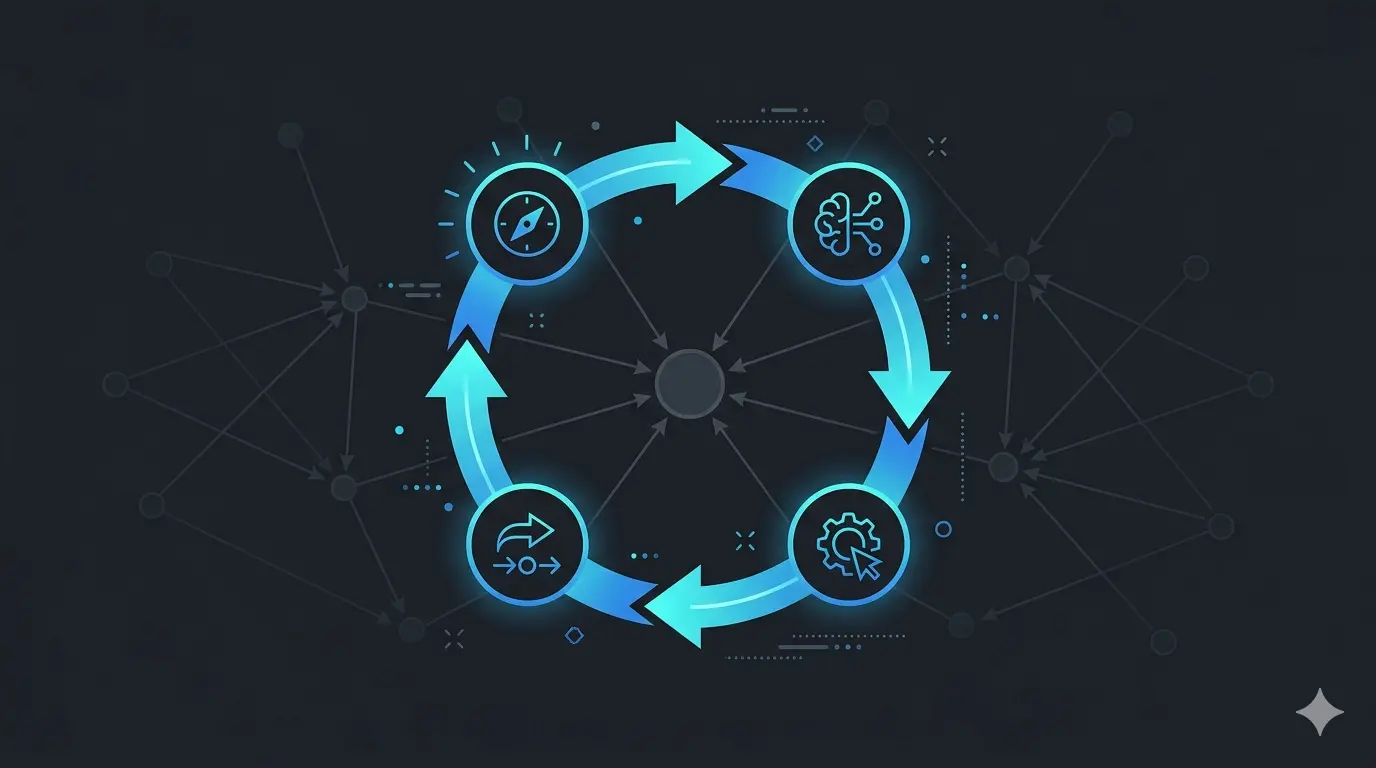
In military strategy, the OODA loop, Observe, Orient, Decide, Act, describes how to process information and adapt faster than your opponent. It translates well to software development, particularly when iterating on design decisions.
This article walks through a concrete example where using the “correct” tooling led to a subtle but significant architectural problem and how recognizing it early produced a simpler, better design.
The Feature
A profile completion score aggregates data from several independent sources: contact info, biography, skills, preferences, experiences, and so on. Each source is fetched by a dedicated use case. The score is expensive to compute, so it must be cached and invalidated whenever a contributing field changes.
First Iteration: Using Standard Tooling
The codebase provides declarative #[Cache] and #[InvalidateCache] attributes. The natural approach is to reach for them.
- Tag all data-fetching use cases with a service tag (
datafield.profile_score) - Inject them into
GetProfileScorevia a tagged iterator - Cache the result under two tags: one per userId, one per full request (which encodes the datafields list)
- On each mutation use case, declare
#[InvalidateCache]pointing to the userId tag
// GetProfileScoreRequest — __toString() encodes userId + hash of datafields list,
// so the cache auto-invalidates when the list of datafields changes
public function __toString(): string
{
    return sprintf('profile_score_%d_%s', $this->userId, md5(implode(',', $this->datafields)));
}

// GetProfileScore : two cache tags: one to invalidate by userId, one to invalidate by request content
#[Cache(tags: ['"profile_score_" ~ request.userId', '"profile_score_" ~ request'])]
public function execute(GetProfileScoreRequest $request): ProfileScoreResponse { ... }

// GetContactInfo : tagged as a datafield
class GetContactInfo implements UseCase, ProfileScoreDatafield { ... }

// UpdateContactInfo : invalidates the score cache by userId
#[InvalidateCache(tags: ['"contact_info_" ~ request.userId', '"profile_score_" ~ request.userId'])]
public function execute(UpdateContactInfoRequest $request): ContactInfoResponse { ... }
It works. Cache is invalidated on mutations, and also automatically on datafields list changes.
Observe: Something Feels Off
Drawing the dependency graph reveals the problem:
GetProfileScore          ──► GetContactInfo, GetBiography, GetSkills, ...

GetContactInfo           ──► ProfileScoreDatafield (interface)
GetBiography             ──► ProfileScoreDatafield (interface)

UpdateContactInfo        ──► "profile_score_" cache tag
UpdateBiography          ──► "profile_score_" cache tag
Knowledge about the profile score has leaked into every use case that participates in it. GetContactInfo is a generic use case, it should not know it contributes to a score. Yet removing it from the score would require modifying the use case itself. A custom PHPStan rule had to be written just to enforce correct attribute usage across all these files.
This is a bidirectional dependency: GetProfileScore depends on the datafields, and the datafields depend on GetProfileScore.
Orient: What Is the Real Constraint?
The real requirement is simple: only GetProfileScore should know what it depends on. The individual use cases should be completely unaware they participate in a score computation.
The standard tooling works well for genuine cross-cutting concerns. But it breaks encapsulation when used to couple unrelated use cases through a shared tag. The score feature’s caching strategy is the score feature’s responsibility, not a distributed one.
Decide: Centralize, Don’t Distribute
The decision: drop #[Cache] and #[InvalidateCache] for the score, handle caching manually inside GetProfileScore, and centralize all knowledge there.
DATAFIELDS: static list of which use cases contribute to the scoreMUTABLE_DATAFIELDS: static list of which mutations should trigger invalidation- An event subscriber wires invalidation without touching the mutation use cases
Act: The Refactored Design
class GetProfileScore implements UseCase
{
    private const array DATAFIELDS = [GetContactInfo::class, GetBiography::class, ...];
    public const array MUTABLE_DATAFIELDS = [UpdateContactInfo::class, UpdateBiography::class, ...];

    public function __construct(
        private readonly ComputeScore $computeScore,
        private readonly CacheProvider $cache,
    ) {}

    public function execute(GetProfileScoreRequest $request): ProfileScoreResponse
    {
        $cacheKey = self::getCacheKey($request->userId);
        $cached = $this->cache->fetch($cacheKey);

        if ($cached === false) {
            $cached = $this->computeScore->execute(...);
            $this->cache->save($cacheKey, $cached, ttl: 90 * 24 * 3600);
        }

        return $cached;
    }

    public static function getCacheKey(int $userId): string
    {
        // Including field names in the key ensures the cache auto-invalidates
        // whenever the DATAFIELDS list is updated (field added or removed).
        return \sprintf('profile_completion_%d_%s', $userId, \hash('xxh3', \implode(',', self::getDatafieldsName())));
    }
}
class ProfileScoreEventSubscriber implements EventSubscriberInterface
{
    public static function getSubscribedEvents(): array
    {
        // Derived entirely from GetProfileScore, single source of truth
        return array_fill_keys(
            array_map(fn($c) => $c . 'Event', GetProfileScore::MUTABLE_DATAFIELDS),
            'onMutation'
        );
    }

    public function onMutation(object $event): void
    {
        $this->cache->delete(GetProfileScore::getCacheKey($event->request->userId));
        $this->getProfileScore->execute(new GetProfileScoreRequest($event->request->userId));
    }
}
Individual use cases now have zero knowledge of the score feature.
Cache Invalidation on Schema Changes, Both Iterations Solve It Differently
Both iterations handle the case where a developer adds or removes a datafield but through very different means.
The first iteration used a second cache tag derived from request.__toString(), which encoded the datafields list as a hash. Mutation use cases invalidated by the userId tag, while a datafields list change would naturally produce a new tag, orphaning the old entry.
The second iteration encodes the same information directly in the cache key:
public static function getCacheKey(int $userId): string
{
    return \sprintf('profile_completion_%d_%s', $userId, \hash('xxh3', \implode(',', self::getDatafieldsName())));
}
Same guarantee, no __toString() magic, no second tag and the logic lives in the one class that owns the concern.
The Result
| First iteration | Second iteration | |
|---|---|---|
| Datafield awareness of score | Yes via interface | None |
| Mutation awareness of score | Yes via cache tag | None |
| Knowledge ownership | Distributed across ~15 files | Centralized in one class |
| Enforcement overhead | 185-line PHPStan rule | Not needed |
| Net code change | additions only | more deletions than additions |
Takeaway
The OODA loop here is tight:
- Observe : the implementation works, but score knowledge leaks across 15+ use cases
- Orient : the real constraint is unidirectional dependency; the score should own its knowledge
- Decide : abandon idiomatic tooling for this specific case, accept a deliberate “non-standard” local solution
- Act : centralize, delete the PHPStan rule, simplify
The lesson is not that declarative caching attributes are bad. They are excellent when a use case genuinely owns its caching concern. The lesson is that pragmatism sometimes means resisting the available tooling when applying it distributes concerns that should stay centralized.
A feedback loop that leads you to delete more code than you write, remove an enforcement rule, and simplify a design is a feedback loop worth trusting.