A Practical Guide to Conventional Commits
 · 4 min
A Practical Guide to Conventional Commits
Conventional Commits is a lightweight specification for writing structured commit messages. It makes changelogs easier to generate, history easier to read, and versioning easier to automate.
The Format
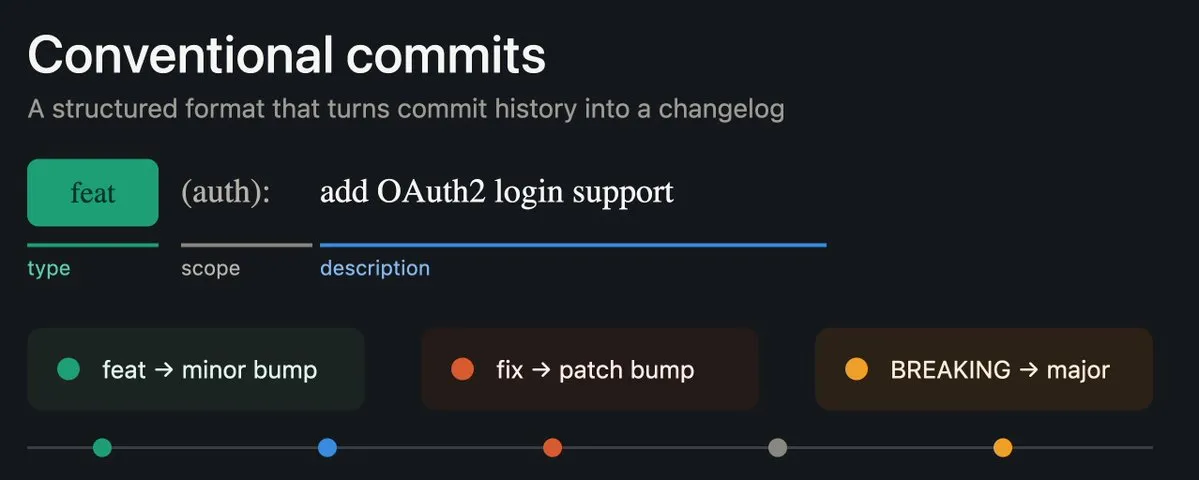
<type>(<scope>): <message>
- type : what kind of change this is (required)
- scope : where in the codebase (optional)
- message : short imperative description (required)
Examples:
feat(auth): add OAuth2 login
fix(cart): correct total price calculation
chore: update composer dependencies
The Spec: Only Two Official Types
The Conventional Commits spec formally defines only two types:
feat: adds user-facing behavior → triggers a minor semver bumpfix: corrects a bug → triggers a patch semver bump
Everything else comes from the Angular commit convention, widely adopted as a de facto standard.
The Angular Type Vocabulary
| Type | Purpose |
|---|---|
feat |
New feature |
fix |
Bug fix |
docs |
Documentation only |
style |
Formatting, whitespace (no logic change) |
refactor |
Restructure without feature/fix |
perf |
Performance improvement |
test |
Adding or fixing tests |
build |
Build system, dependencies |
ci |
CI/CD pipeline changes |
chore |
Other maintenance tasks |
revert |
Reverts a previous commit |
feat vs chore
The key question: would a user or API consumer notice this change?
- Yes →
feat(orfix) - No →
chore
feat: add job posting search index     ← new capability for users
chore: update CI node version          ← internal, invisible to users
refactor and perf are worth distinguishing from chore, they signal why the code changed without implying a visible behavior change.
Scopes: Optional but Valuable
Scopes answer “where?” (a module, domain, or layer name).
feat(search): add faceted filtering
fix(user): prevent duplicate email registration
ci(docker): pin base image version
Without scope is equally valid when the context is obvious or the repo is small.
Tips
- Be consistent : partial use of scopes is worse than none
- Keep them short :
auth,api,db,user,payment - Consider enforcing an allowed list in
commitlinton larger projects
Custom Types
The spec allows custom types. If your team maintains a content repo, content(article): add guide to conventional commits is valid as long as your team aligns on the vocabulary and your linter allows it.
Only feat and fix carry reserved meaning (semver). Everything else is convention.
Breaking Changes
Any type can signal a breaking change with a ! or a BREAKING CHANGE: footer:
feat!: remove deprecated v1 endpoints

BREAKING CHANGE: /api/v1 is no longer available, migrate to /api/v2
This triggers a major semver bump regardless of type.
Summary
| Spec | Angular convention | |
|---|---|---|
| Required types | feat, fix |
+ 9 more |
| Scope | Optional | Optional |
| Custom types | Allowed | Allowed |
| Breaking changes | ! or footer |
Same |
Start with the Angular vocabulary, add scopes when your repo grows, and define custom types only when none of the standard ones fit.